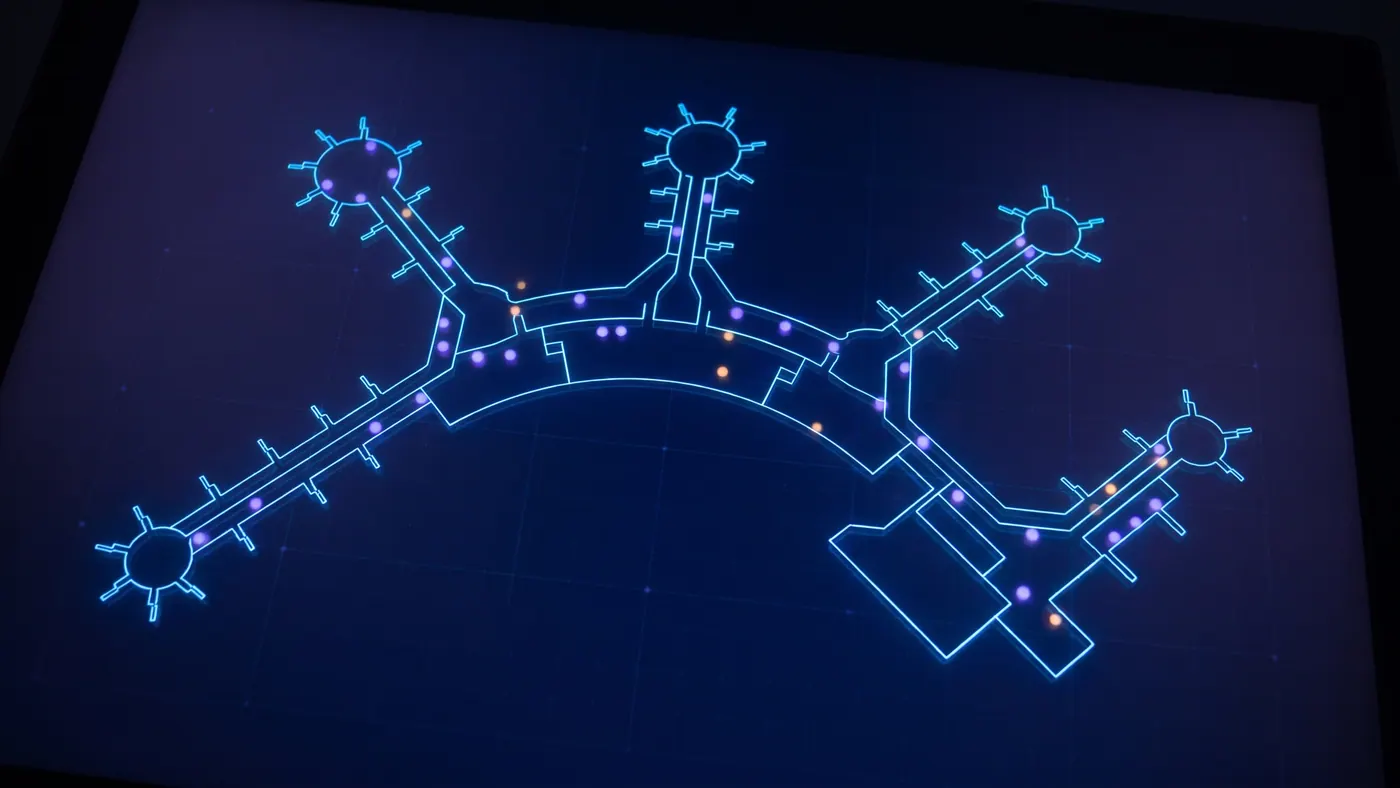
Finding your sleeping spot in the terminal
Airside or landside, quiet corner or open concourse — how to pick a spot that actually lets you rest.
- Should I stay airside or landside tonight?
- Which seats are actually comfortable for sleeping?
- Where will staff move me along, and where won’t they?
- What do I do if my gate area has nowhere good to rest?
How it works
Every terminal has better and worse places to spend the night, and the difference is rarely obvious from a map. Two rows of identical chairs can feel completely different depending on what is nearby, what the lighting does after midnight, and whether staff treat that corner as a thoroughfare or a dead end.
This page is about reading a terminal the way a frequent overnighter does: knowing which side of security to be on, which seating actually works, and which spots look fine but are not built for lingering.
Airside or landside — decide this first
This is the single biggest decision, and it is not really a preference — it is usually made for you by your ticket and visa status. Airside means past security and passport control; landside means before it. Get this wrong and you may find yourself re-clearing security at 4 a.m., or stuck somewhere that closes.
- Airside: generally calmer, more consistently staffed, and where most overnight facilities — lounges, quiet rooms, pods — are concentrated. Requires a valid onward boarding pass.
- Landside: more transport and food variety, useful if you are arriving early for a flight rather than in transit, but some airports close these public areas overnight entirely.
- Check your specific airport’s guide on this site before you assume either side is open all night — it varies more than people expect.
What a good spot actually looks like
Comfort at 3 a.m. has less to do with plush furniture and more to do with three physical details: whether the seat has a fixed armrest in the middle, how far you are from the nearest active gate, and what the airflow feels like at ground level.
- Armrest-free benches or rows let you lie down properly — scout for these specifically rather than settling for the first empty chair.
- Distance from active gates matters more than distance from shops; a closed shop is silent, a boarding gate is not.
- Floor-level vents and glass walls both radiate cold overnight — a spot that looks fine at 9 p.m. can turn uncomfortably cold by 2 a.m.
- Carpeted or quieter-flooring areas dampen the sound of luggage wheels and footsteps far better than open tile concourses.
Do one lap of your available area before choosing a spot. The quietest corner is rarely the first bench you pass.
Where you will get moved along
Not every open seat is meant for overnight use. Some areas are kept clear for operational reasons, and staff will ask you to shift even if nothing is posted.
- Seating immediately in front of security checkpoints or immigration desks, which need to stay clear for flow.
- Areas directly beneath active departure boards or near gate podiums during boarding pushes.
- Anywhere cleaning crews cycle through on a fixed overnight schedule — you will typically be asked to lift your feet or move rather than stay put.
When the map has nothing good
Some terminals, especially smaller or older ones, simply were not built with overnight rest in mind. If a genuine walk-through turns up nothing quiet, dim or armrest-free, that is useful information on its own — it is a sign to price a lounge day pass, a sleep pod, or a short hotel stay rather than force an uncomfortable night on a bad bench.
If you are traveling with family, prioritize proximity to restrooms and staffed areas over finding the single quietest corner — visibility and convenience matter more with children.
Common questions
Is it actually allowed to sleep in an airport terminal?
At the great majority of airports, yes — there is no rule against resting in public seating areas, though staff may ask you to move from specific operational zones. A handful of airports discourage or restrict it; check your airport’s specific guide if you are unsure.
Is airside always better than landside for sleeping?
Usually, but not always. Airside tends to be calmer and better staffed, but a few airports keep landside areas open around the clock while closing airside seating between flight banks. Check what your specific airport does before assuming.
What if security or staff tell me to move?
Move without arguing — it is almost always for an operational reason, like a cleaning cycle or a shift in gate activity, not personal. Ask where nearby is fine to use instead; staff usually know the quiet spots better than any map.
Are there seats specifically designed for sleeping?
Some airports install benches without fixed armrests, recliners or dedicated quiet rooms specifically for this. Others only have standard divided seating. Our airport guides note which type predominates so you know what to expect before you land.