Airport sleep pods and capsule hotels
What you actually get for your money, how the hourly booking works, and when a pod is the wrong call.
Ways in
Airports with sleep pods
Every airport we cover that has pods, cabins or capsules you can book by the hour.
- Sleep lounge cabins
- Airside capsule hotel
- Transit sleeping pods
- Rest cabins
- GoSleep pods
- Capsule-style rooms
- Capsule accommodation
- Napcabs
- Napcabs
At 3 a.m., the question is never really "what is a sleep pod". It is whether the thing you are looking at on your phone will get you four hours of actual sleep, and whether it is worth what it costs. This page answers that.
What a sleep pod actually is
The term covers several different products that airports and operators use interchangeably. The one thing they share is that you rent them by the hour rather than by the night, and they sit inside the terminal rather than a shuttle ride away.
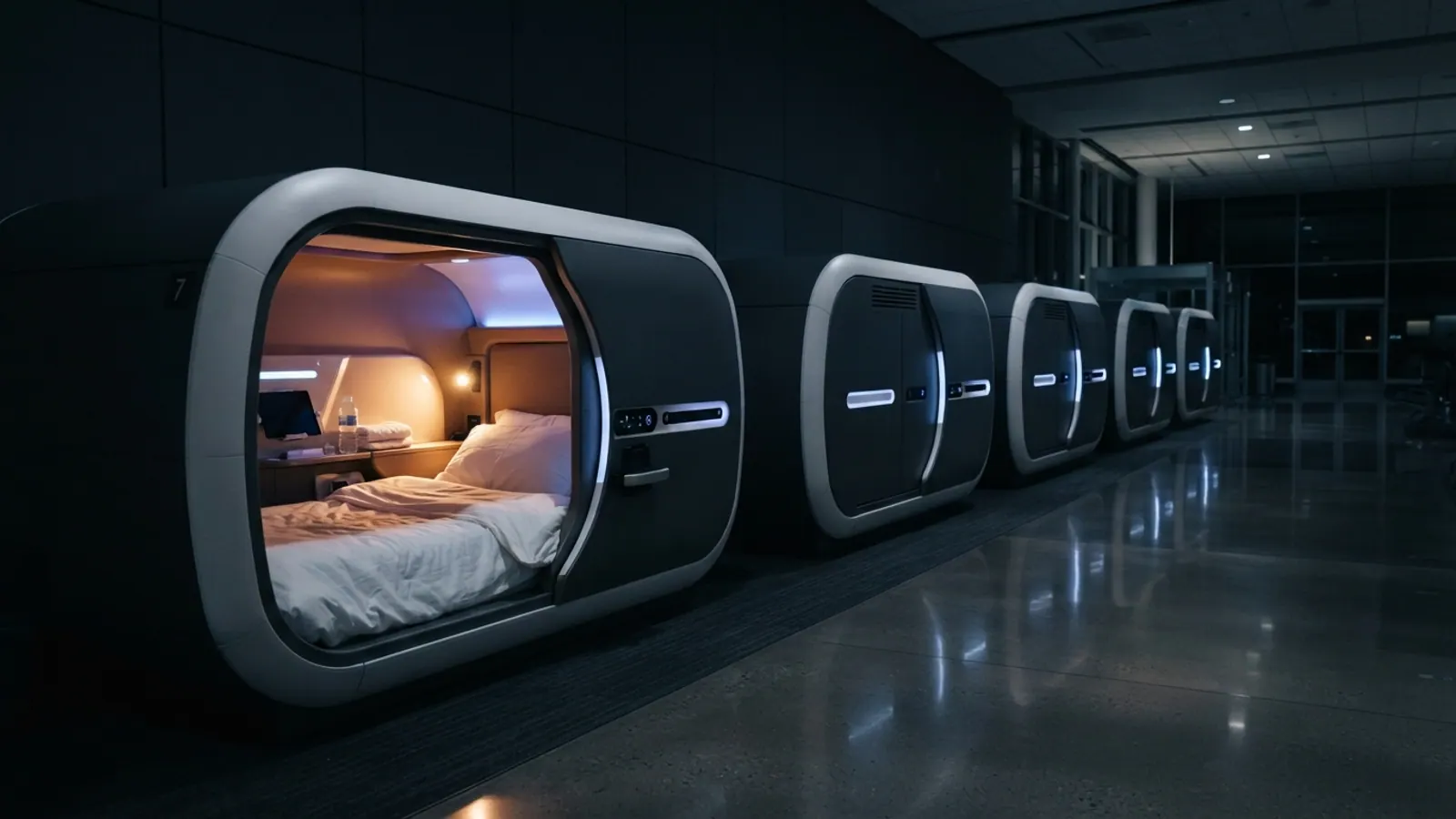
- Sleep cabins: a small lockable room with a proper flat bed, a light you control and ventilation you control. Napcabs at Frankfurt and Munich are the type example, and YOTELAIR cabins at Heathrow, Paris CDG, Amsterdam and Istanbul are the larger version with a private shower.
- Recliner shells: a lie-flat or near-flat seat with a cover or hood you pull over yourself for darkness. GoSleep pods at Helsinki work this way. Cheaper than a cabin, and no lockable door.
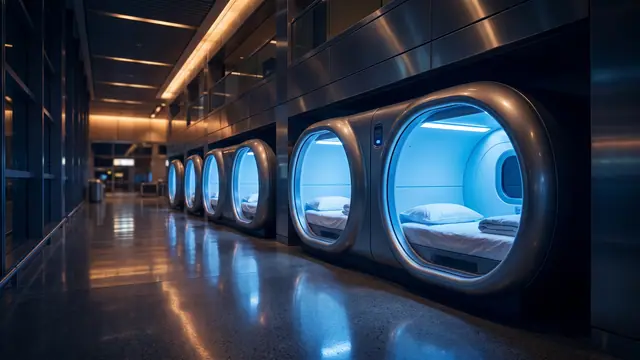
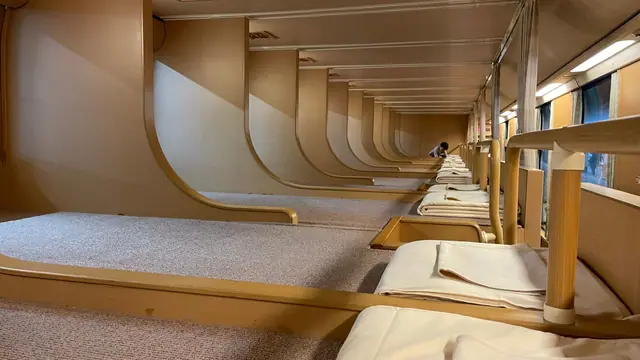
- Capsule berths: a bunk-sized private compartment with a curtain or hatch, and shared bathrooms down the corridor. Common at Kuala Lumpur, Narita and Tokyo Haneda.
- Pod-branded transit rooms: at some hubs, notably Delhi and Dubai, the operator sells what is effectively a tiny hotel room by the hour and calls it a pod.
What it is not: a hotel room. There is usually no wardrobe, no bath, no room service, and often nowhere sensible to put a large suitcase except beside the bed. Walls between units are thin. Cleaning happens between bookings, quickly. Set your expectations at "clean, dark, private, small" and you will not be disappointed.
How the hourly pricing usually works
Almost every pod operator sells time in blocks with a minimum, then charges for extensions. The per-hour rate typically drops the longer you book, so a six-hour block rarely costs twice a three-hour one. As a rule of thumb, a pod costs less than an airport hotel room and more than a lounge day pass, and it is the only one of the three that guarantees you a bed.
- There is normally a minimum block, so a ninety-minute nap may cost you the same as three hours. Check before you assume you can pay for exactly what you use.
- Extending mid-stay depends on whether someone has booked the unit after you. On a busy night, assume you cannot.
- Showers are sometimes included in the cabin, sometimes a shared facility with its own charge, and sometimes absent entirely.
- Peak overnight hours are the expensive ones, which is the opposite of how hotel day rates usually behave.
- Cancellation terms on short bookings tend to be tight or non-existent.
Pods sell out. There are rarely more than a dozen units at any airport, crew use them too, and a single cancelled long-haul flight can clear the lot. If your layover is planned, book before you fly rather than hoping to walk up at midnight.
Airside or landside decides everything
This is the detail that ruins more pod bookings than price ever does. A pod past security is one you can use without clearing immigration, without re-queueing for a security check, and without needing a visa for the country you happen to be transiting. A pod in the public arrivals hall is none of those things, and for a transit passenger it may be completely unusable.
- Airside pods suit anyone connecting between two international flights, especially where the transit visa rules are awkward.
- Landside pods and capsule hotels suit anyone ending their journey here, or starting it with an early departure.
- Some airports have both, in different terminals, sold under the same brand name. Read the terminal on the booking page, not just the airport.
- If you book landside and you are in transit, budget real time for immigration on the way out and security on the way back in.
Pod, lounge, transit hotel or bench
A lounge is better value when you want food, a shower, Wi-Fi and a comfortable chair for a few hours, and your access is already covered by a card, status or ticket. A pod wins the moment sleep is the actual goal: the lounge chair does not go flat, the lights stay on, and at many airports the lounge closes for exactly the hours you needed it. A transit hotel wins on a genuinely long gap, seven hours or more, where a real room and a real bathroom stop being a luxury. A bench wins on money and nothing else.
What to check before you book
- Which side of security it sits on, and which terminal.
- Walk time from the pod to your departure gate. At a large hub this can be twenty-five minutes, and you will be doing it half asleep.
- The minimum block, and whether it fits the shape of your layover.
- Whether a shower is included, extra, or not available.
- Whether the unit locks, or is a curtain. This changes what you can do with your bags and how well you will sleep.
- Whether reception is staffed overnight, or whether check-in is a screen on the unit itself.
Who pods are worst for
Tall travelers should check the bed length before booking anything described as a capsule or a shell. These units are built to a standard that does not flatter anyone much over six foot. Couples generally cannot share a single-occupancy cabin, and where a double exists it is priced closer to a hotel room. Families are the hardest case: most pods are sold as single-occupancy, children usually cannot be left in a separate unit, and a connected airport hotel almost always works out better. And if your layover is under three hours, the walk, the check-in and the minimum block will eat most of what you paid for.
Noise and light, honestly
A lockable cabin with its own lighting control is genuinely dark and genuinely quiet, and it is the closest thing to a hotel room inside a terminal. A recliner shell or an open capsule bay is neither. You are still in a lit building with announcements, cleaning trolleys and other people's alarms, and the cover over your head does more for privacy than for silence. Bring an eye mask and earplugs regardless of what you booked. Nobody has ever regretted packing them.
Related guides
Common questions
How much do airport sleep pods cost?
There is no single answer, because rates vary enormously by airport and by what you are actually renting. The reliable generalisation: a pod costs less than a room at an airport hotel for the same stretch of hours, more than a lounge day pass, and considerably more than nothing. Rates are usually quoted per block of hours rather than per night, and the per-hour cost falls the longer you book.
Are airport sleep pods worth it?
They are worth it when sleep is the actual goal and your layover is long enough to use the minimum block properly — roughly four hours or more, at an airport where the alternative is a lit concourse and an armrest in your ribs. They are poor value on a short gap, for two people travelling together, or at an airport that already has free recliner zones and dimmed rest areas.
Can you sleep in an airport pod for a few hours?
Yes — that is exactly what they are designed for. Almost all pod operators sell time in blocks of a few hours rather than overnight stays. Check the minimum block before booking, since a very short nap may cost the same as a longer one, and assume you will not be able to extend on a busy night.
Which airports have sleeping pods?
Coverage is patchy and concentrated in Europe, Asia and the Gulf. Frankfurt and Munich have Napcabs sleep cabins, Helsinki has GoSleep recliner pods, and YOTELAIR operates cabins at Heathrow, Paris CDG, Amsterdam Schiphol and Istanbul. Delhi and Dubai sell pod-style cabins by the hour airside, and Kuala Lumpur, Narita and Tokyo Haneda have capsule accommodation. Most large North American airports have nothing of the kind.
Are sleep pods private?
It depends on which type you booked. A sleep cabin is a small room that locks from the inside, and is genuinely private. A capsule berth is a compartment with a curtain or hatch and shared bathrooms, so it is private enough to change in but not soundproof. A recliner shell with a pull-over cover gives you visual privacy and very little else.
Do you need to book an airport sleep pod in advance?
Where you can, yes. Airports rarely have more than a handful of units, airline crew use them, and one cancelled long-haul flight can fill every one of them within minutes. Walk-up availability exists at quieter airports and on quiet nights, but it is not something to build an overnight plan around.